01
Detection
Client + People PotentialSelects which tensions are genuinely live and where the friction concentrates.
PEOPLE POTENTIALCONVERSATIONAL INTELLIGENCE · DETECTION LAYER
Every day, people signal where work is becoming difficult, trust is thinning, decisions stall and energy is being lost. The challenge is not collecting more noise. It is knowing where to look and starting the conversations that bring the real issue into view.
A People Potential product · Extraction powered by Haven, a FeedbackRocket innovation
ONE ENGINE · FOUR LAYERS
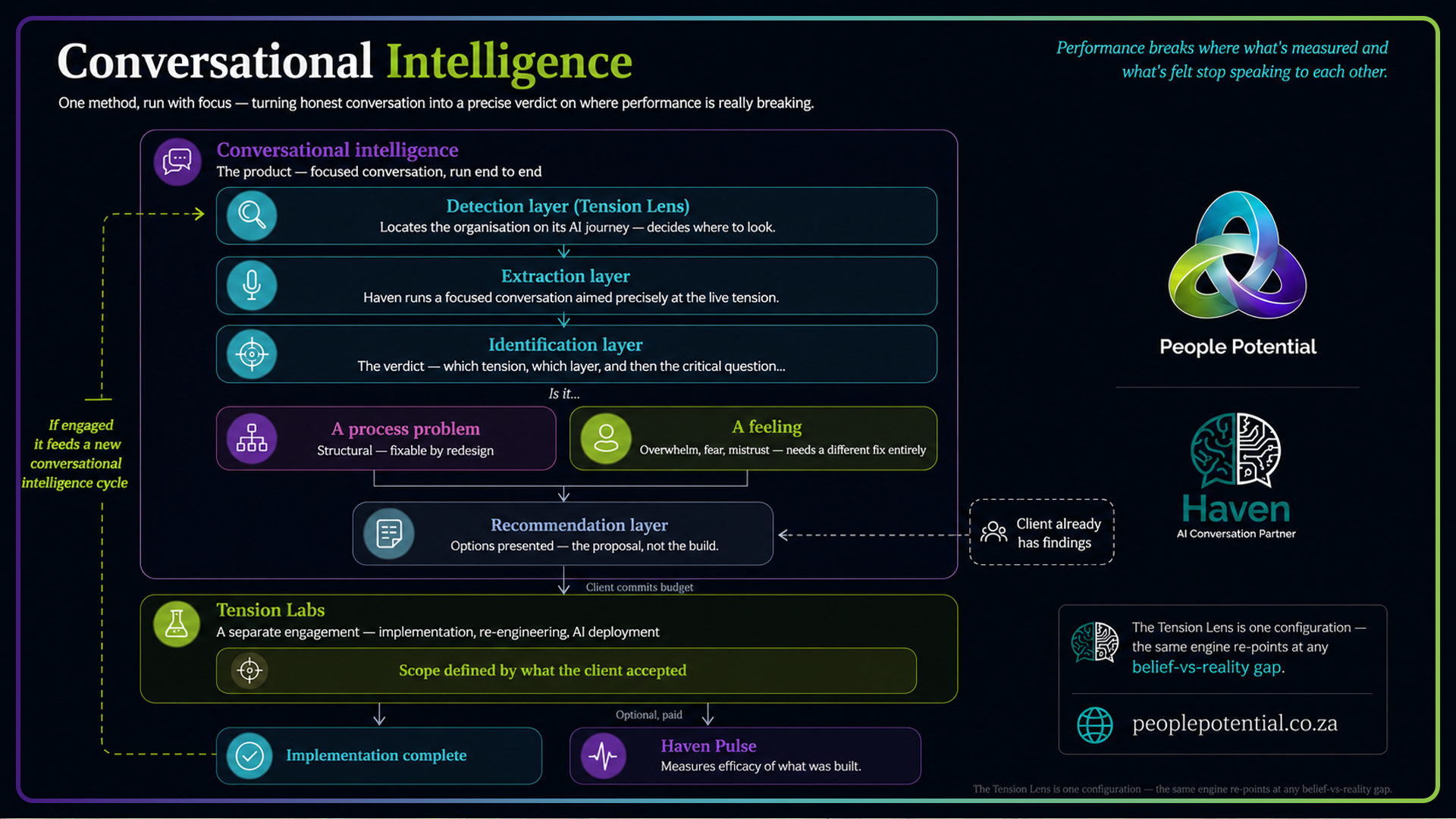
THE TENSION LENS
Detection decides where to look. Focused conversation extracts lived experience. Identification names the tension and Recommendation presents practical next options.
Download the brochureSelects which tensions are genuinely live and where the friction concentrates.
Runs focused, adaptive conversations aimed at each participant’s own signal.
Experience Haven for yourself
Attributes patterns, emotional register and source layer; distinguishes process from people.
Turns verdicts into sequenced options with named AI–HI modes and success metrics.
WHAT THE DETECTION LAYER IS
It does not diagnose or identify the tension. It frames the context, decides where to look and creates focused conversation starters around the live organisational challenge.
Focused, adaptive conversations reveal lived experience: pressure, hesitation, rework, avoidance and what remains unspoken.
Evidence identifies the tension, where it sits and the critical question.
The evidence distinguishes a process problem from a feeling, then proposes options rather than presuming the intervention.
THE FULL TENSION LENS
The Lens does not assume the intervention. It creates a disciplined route from an organisational challenge to evidence, shared understanding and practical next options.
Set the scene. Configure the context and conversation starters around the challenge.
Have focused, adaptive conversations and hear the lived experience beneath the noise.
Name the tension, where it sits - strategy, tactics or operations - and the critical question.
Is it a process problem requiring redesign, or a feeling such as fear, mistrust or overwhelm requiring a different response?
Present evidence-based options. The recommendation is the proposal, not the build.
Use Tension Labs and Haven Pulse to implement, re-check and see whether the tension is shifting.
ONE PRACTICAL USE CASE · AI-HI INTEGRATION
Lumenbridge Advisory shows how the Detection Layer can be applied when the tension is known: AI is being adopted, but the work, decisions and human experience are not yet integrating around it.
First-principles thinking gives people permission to look beyond inherited processes without assuming the organisation must start again. We explore what could be possible, then compare it with the existing business and its real strengths, constraints, readiness and appetite for change.
Temporarily set aside today's process. What might purpose-led work look like with AI available?
What already works, what creates friction, and what exists for good reasons?
What should we keep, improve, redesign, stop or explore before committing?
What can change now, what needs evidence, and what should be considered later?
AI–HI FIRST-PRINCIPLES REVIEW
A facilitated working session for leaders and people close to the work. Together, we explore the possibilities AI creates, surface inherited assumptions and compare the future opportunity with how the organisation works today.
The output is not a target-state blueprint or a list of AI tools. It is a practical opportunity map showing what to protect, what may be ready to change, what needs evidence and what belongs on a longer horizon.
ONE ENGINE · FOUR LAYERS
THE TENSION LENS
Detection decides where to look. Focused conversation extracts lived experience. Identification names the tension and Recommendation presents practical next options.
Download the brochureSelects which tensions are genuinely live and where the friction concentrates.
Runs focused, adaptive conversations aimed at each participant’s own signal.
Attributes patterns, emotional register and source layer; distinguishes process from people.
Turns verdicts into sequenced options with named AI–HI modes and success metrics.
STRUCTURED MEASUREMENT
ADAPTIVE CONVERSATION
ONE EVIDENCE BASE
This is not numbers versus opinion. It is two empirical views of the same organisational reality.
WHERE THE FRICTION ORIGINATES
We locate the source of a tension so the response addresses its cause. A problem experienced in daily work may have been created by a management practice or a strategic contradiction further upstream.
The organisation's purpose, value proposition, priorities, choices, risk appetite and boundaries. Strategy decides what matters and what the organisation will not do.
Examples: growth choices, client promise, AI ambition, investment priorities.The structures and management system that translate strategy into coordinated action: decision rights, policies, resource allocation, leadership practice and controls.
Examples: approval thresholds, governance, team design, performance signals.The lived workflow: roles, tools, handoffs, routines, exceptions and the practical experience of employees and clients as value is created.
Examples: case handling, reviews, client delivery, daily use of AI tools.If an operational symptom comes from a tactical or strategic cause, adding another tool or training course will not solve it. It may simply automate the problem.
EXECUTIVE SNAPSHOT
Scores are illustrative and shown consistently out of 100. Higher scores indicate a stronger positive experience in this section.
CRITICAL MINORITY SIGNALS
have concealed AI-assisted work because expectations feel unclear
are unsure who is accountable when an AI-supported decision is wrong
say faster first drafts have not reduced approval time or rework
WHAT IS WORKING
The organisation is not starting from resistance. It has professional pride, client commitment and a strong appetite to learn.
Employees care deeply about the standard and credibility of their work.
AI interest is strongest where it creates more time for valuable client thinking.
Most employees want practical guidance and role-relevant practice, not generic training.
Informal communities are already spreading useful practice across team boundaries.
“I do not want AI to do the thinking for me. I want it to give me more time to do the thinking only I can do.”Illustrative composite employee voice
THE TENSION ARCHITECTURE
Each tension is a trade-off the organisation must manage, such as speed versus quality. Select one to see where the pressure sits and what the evidence suggests.
The number is a friction signal out of 100: the nearer it is to 100, the stronger or more concentrated the pressure. It is not a percentage of employees.
Organisational design
Where do decision rights actually sit - structurally, not on paper?
Decision authority is understood at executive level, but becomes inconsistent when translated through management.
Employees are not resisting accountability. They are learning decision rights through rejected attempts and repeated escalation.
“The policy says I own the outcome, but every unusual decision still travels two levels up.”Illustrative composite employee voice
“You learn where your authority ends by having the work sent back.”Illustrative composite employee voice
Design explicit decision rights, then introduce AI-suggested routing for low-risk approvals while managers retain authority.
Within a tension, it is the fraction of coded passages where an employee describes the organisation’s stated position as out of step with lived experience. It is not the percentage of employees who disagree.
FROM VERDICT TO ACTION
Every proposal names its source tension, originating layer, AI–HI mode and success measures before anything is built.
AI informs; a person initiates and authorises.
AI recommends; a person approves before action.
AI runs the process and pauses at defined risk points.
AI acts within pre-agreed, low-risk boundaries.
Human Judgment vs Automation · Strategy & Tactics
Define who initiates, recommends, authorises and remains accountable for each priority use case.
Centralisation vs Empowerment · Tactics
Use explicit thresholds and AI-supported routing to remove back-and-forth without removing managerial authority.
Speed vs Quality · Strategy–Tactics boundary
Align leadership language, management behaviour, delivery thresholds and recognition with the stated quality commitment.
Judgment + Psychological Safety
Make it legitimate and easy to question, override and disclose AI-supported work without diffusing accountability.
Capability vs Readiness · Tactics & Operations
Create role-based practice loops, exemplars and peer learning around real client work, with defined risk checkpoints.
WHERE AI CARRIES THE LOAD
AI supports the administration beneath implementation. People retain ownership of every decision, relationship and act of trust-building.
PHASE 2 · THE LIVING SYSTEM
The hub becomes the single source of truth for implementation, evidence, ownership, progress and the next organisational question.
From non-believer to informed participant.
Turn accepted recommendations into working practice.
Measure efficacy and redirect capacity to higher-value work.
YEAR ONE SEQUENCE
Name the tensions and earn the right to be believed.
Build informed participation and role-level relevance.
Implement accepted decision, workflow and manager changes.
Read early behaviour and friction movement.
Compile lead indicators and correct the course.
Redirect capacity and mature AI–HI practice.
Refresh the evidence after action.
HAVEN PULSE
A short, targeted version of the original conversation re-runs against the same tensions and success measures. It is not a fresh diagnostic; it tests whether the human signal is moving after implementation.
ONE SOURCE OF TRUTH
The hub makes a substantial evidence pack usable on demand. Each layer can be updated once without circulating new document versions.
The answer, the scale, what is working and the material risks.
All themes, continuums, layer patterns and source-linked evidence.
Every proposal mapped back to its finding, origin and success measure.
Owners, actions, progress, decisions, Pulse results and the next cycle.
CONVERSATIONAL INTELLIGENCE
The demonstration is fictional. The method, tensions and decision discipline are real.